The Inversion: What Happens When Your Team Stops Following and Starts Leading
The best teams don't follow their leader. They finish their sentences.

I walked into the team room at BD one morning and heard laughter. Not the polite kind. The kind that happens when people are genuinely having fun solving hard problems together. I stood in the doorway for a second and just listened. Nobody was waiting for direction. Nobody was blocked. Nobody was performing productivity for the manager who just walked in. They were just in it, together.
I thought: we did it.
A few weeks later I sat down to prep for my leadership meeting and found the notes already waiting. Risks flagged. Updates summarized. Every question I was going to get asked, already answered. My team had modeled exactly what I needed before I opened my mouth. They didn’t ask what format I wanted or what I was worried about. They already knew.
At Ren AI it looked different but felt identical. The dev team showed up with product improvement ideas I hadn’t asked for. Not feature requests. Actual strategic thinking about where the product should go next. They weren’t waiting for direction. They were generating it.
That’s The Inversion.
And once you’ve felt it, you spend the rest of your career trying to build it again.
What it actually feels like
There’s a hum to it. That’s the only word that fits.
Not a meeting that went well or a quarter where the numbers came in. It’s a frequency the whole team starts operating on. Everyone is slightly ahead of where they need to be. Problems get solved before they get escalated. You walk into a room and feel understood rather than needed.
In sports they call it flow. In battle it’s the difference between a unit executing orders and a unit that anticipates the fight before it arrives. The best teams I’ve ever been on had it. The worst ones were burning energy trying to manufacture it through process and structure and accountability systems, which is exactly the wrong tool for the job.
You can’t process your way to the hum. You have to earn it.
The currency is trust. Specifically: trust built through survived difficulty. Trust that was tested by pivots and pressure and uncertainty and held. Trust that the leader is in your corner even when they can’t tell you everything. Trust that the team is moving toward the same thing even when the path changes underneath you.
The Inversion is what trust looks like when it fully matures. And it doesn’t arrive all at once. It builds through stages, each one more legible than the last once you know what you’re looking for.
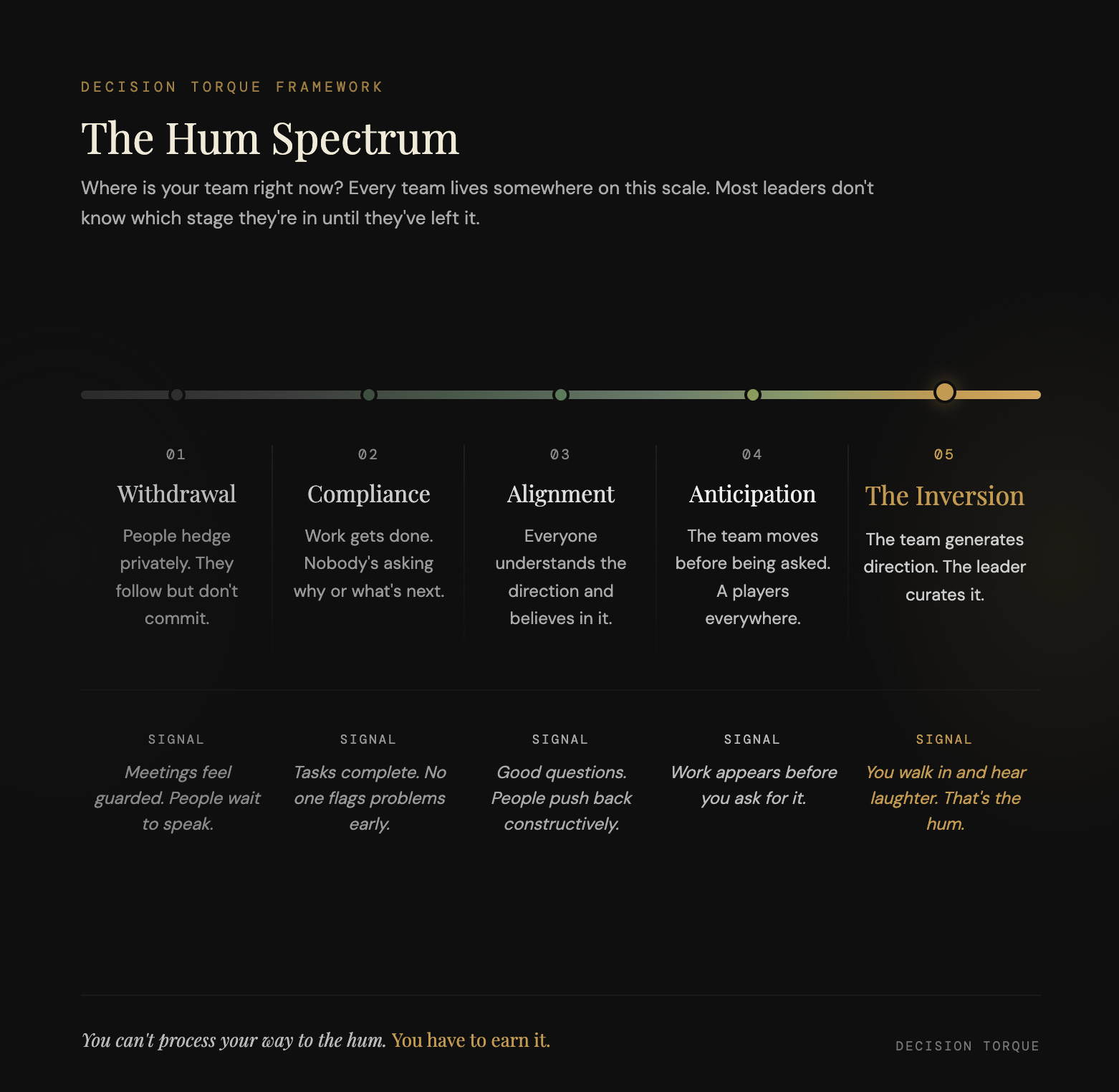
Most teams I’ve worked with were somewhere in the middle, aligned but not anticipating, following well but not yet generating. The gap between Anticipation and The Inversion is the hardest one to close because it’s not a skill gap. It’s a trust gap.
The A player insight
Every team has one. The person who just knows.
They anticipate what you need before you ask. They show up to meetings with the answer to the question you were about to raise. They move early, not because they were told to, but because they’ve internalized how you think well enough to run your decision-making process on their own.
We call these people A players and we treat them like they’re rare because they are. Most teams have one, maybe two.
The Inversion is what happens when that capability stops being individual and becomes collective.
It’s not that everyone becomes an A player in the traditional sense. It’s that the whole team starts operating as a single distributed intelligence that has absorbed the leader’s mental model deeply enough to generate direction rather than just receive it. The A player’s superpower scales across the entire room.
When I stood in that BD doorway hearing laughter, what I was actually hearing was a team that had stopped running on individual effort and started running on a shared operating system they’d built together. Not through a workshop or a values exercise. Through every difficult conversation, every survived pivot, every moment I chose to explain why the direction was changing instead of just announcing that it had.
That’s what you’re actually building when you narrate your thinking out loud. Not compliance. Not alignment. A shared operating system. The Inversion is the moment it boots up across the whole team.
What happens to the leader
Here’s where it gets uncomfortable.
Most leaders spend years trying to get their teams to think independently, anticipate needs, drive proactively. And then when it actually happens, the instinct is to fill the space anyway.
Keep initiating. Keep directing. Keep being the visionary in the room because that’s the identity that got you here. The team is moving and you accelerate to get back in front because being out front is what leaders do.
That is exactly the wrong move.
When the team reaches The Inversion, your job changes. You move from architect to curator. From initiating force to directing it. You’re no longer the one generating all the ideas. You’re the one recognizing the best ideas coming from the team, amplifying them, protecting them, and occasionally redirecting when they drift.
That’s a harder job than it sounds. It requires a specific kind of confidence. The kind that doesn’t need to be the smartest person in the room. The kind that can sit with not being the one who thought of it first and find genuine satisfaction in watching people exceed what you imagined for them.
The leaders who struggle here are the ones whose identity is too tightly wrapped around being the source. When the team doesn’t need them to initiate, they feel unnecessary. So they re-insert themselves in ways that quietly signal to the team that their proactive thinking isn’t actually trusted.
The team feels that immediately. And they adapt back toward self-protection. Every time.
The fragility nobody warns you about
The hum is not self-sustaining. I wish someone had told me this earlier.
One bad pivot handled without transparency. One public override of a call the team got right. One moment of grabbing the wheel when the pressure spiked. And the frequency shifts. You can feel it before anyone says a word. Meetings get slightly more formal. People start waiting to be asked instead of offering. The notes stop appearing before you ask for them.
The Inversion doesn’t end with a dramatic moment. It dissolves quietly. Nobody announces they’ve stopped trusting it. They just gradually rebuild the self-protective habits that trust had replaced.
And it’s almost always the leader who breaks it. Not the team. Not out of malice. Out of pressure. Out of the very human instinct to grab the wheel when the road gets rough, even when the team was navigating it just fine.
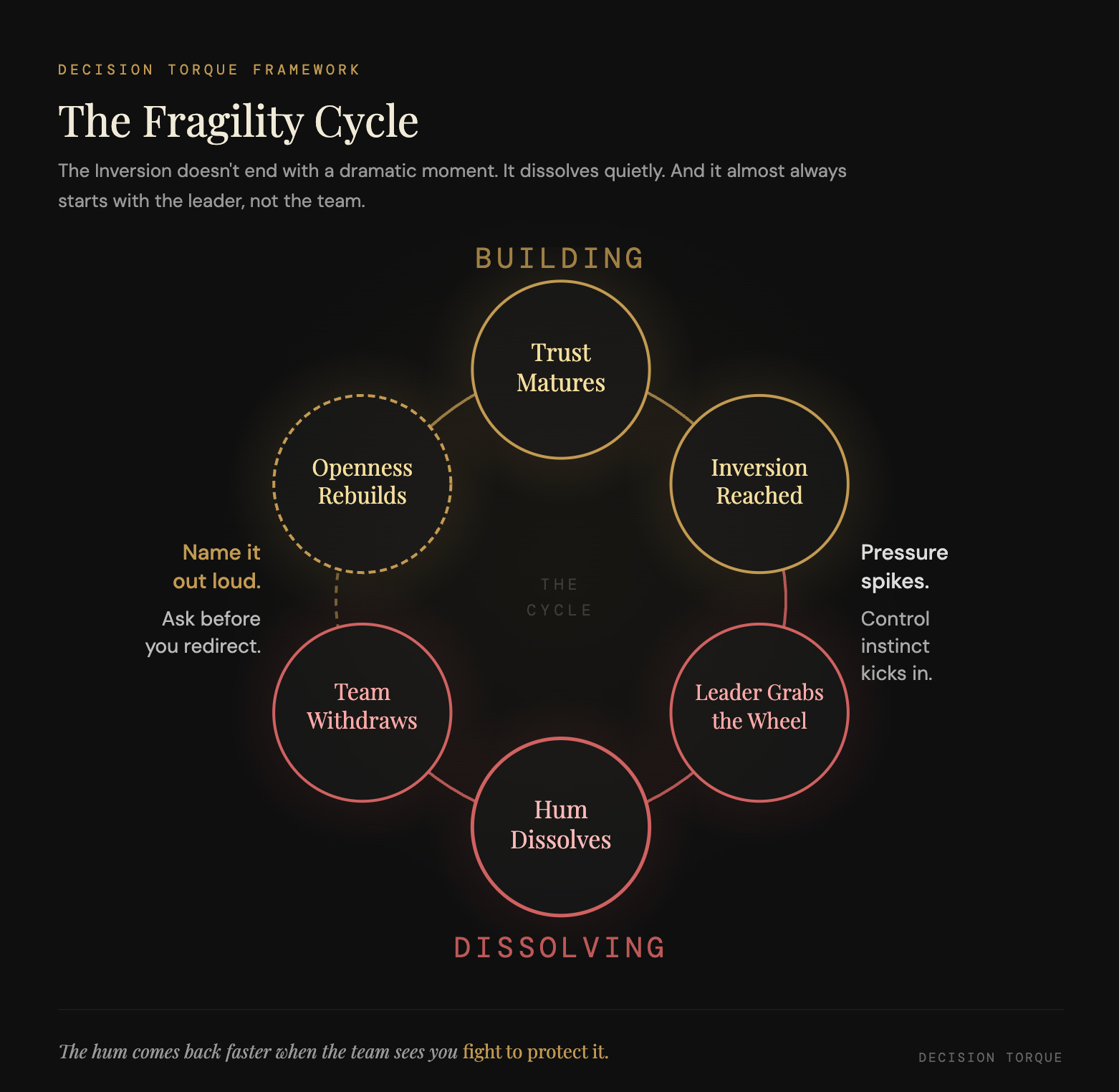
That cycle is worth studying. Not because it’s inevitable, but because knowing the pattern means you can catch yourself earlier. The moment you feel the urge to override without explaining, that’s the signal. That’s where the hum starts to go quiet.
The antidote is the same thing that built it: transparency. When you feel the urge to override, name it out loud instead. When you’re worried the team is drifting, ask before you redirect. When the pressure is highest and the instinct to control is loudest, that is exactly the moment to demonstrate that the trust runs both ways.
The hum comes back faster when the team sees you fight to protect it.
Why any of this matters
Not every team gets here. Not every leader builds the conditions for it. Not every organization has the psychological safety underneath it that makes it possible. The Inversion requires everything that came before it and a lot of teams never get through all of that intact.
But the leaders who’ve felt it once know exactly what they’re building toward every time they start over. Every new team. Every new role. Every inherited mess of broken trust and defensive habits. Underneath all that work is the memory of what it felt like when the team already knew what you needed before you asked.
That laughter in the BD doorway. The meeting notes waiting before I’d even sat down. The Ren AI dev team showing up with the next idea before I’d finished forming the question.
That’s not a management outcome. That’s not a metric. That’s what work feels like when it’s actually working.
Everything in Decision Torque, every narrated pivot, every honest conversation about why the direction is changing, every moment you chose transparency over control, is just the path to get back there.
The hum is the whole point.